
Discuss EtherCAT/CAN FD requirements, sample availability, and lead-time assumptions.

GaN Servo Drives LogoGaN Servo Drives
Request RFQ
GaN Servo Drives LogoGaN Servo Drives

High-performance GaN servo drives and motion electronics manufactured in Shenzhen & Dongguan.

Inquiry Email

[email protected]

Email app

Include voltage, current, motor, encoder, protocol, board envelope, and quantity stage.

Instant Chat

+86 18857971991

Chat on WhatsApp

Direct response from our engineering team.

Products
  • GaN Low-Voltage Servo Drives
  • 48V Servo Driver Board
  • Driver-Encoder Integrated Servo Board
  • Robot Joint Servo Drive
  • EtherCAT 48V Servo Drive
  • CAN FD Servo Drive
Solutions
  • Humanoid Robot Joints
  • Collaborative Robot (Cobot) Joints
  • AMR and Mobile Robot Servo Drives
  • Exoskeleton and Prosthetics Servo Drives
  • GaN Servo Drive Selection Guide
  • EtherCAT & CAN FD Integration
OEM Capabilities
  • OEM Robot Joint BOM & Customization
  • Rigorous Compliance & Quality Control
  • Deep OEM Custom Solutions
  • Engineering File Request Center & CAD Resources
Resources
  • Blog
  • Factory
  • Contact / RFQ
  • Privacy Policy
  • Cookie Policy
  • Terms of Service
© 2026 GaN Servo Drives. All Rights Reserved.|Backed by Linkup Ai Co., Ltd. Manufacturing delivered by the Advanced Manufacturing Division of Linkup Precision.|Legal entity: Linkup Ai Co., Ltd.
← Back to Products

Driver-Encoder Integrated Servo Board

A 2-in-1 PCBA combining a high-performance servo drive with a high-resolution absolute magnetic encoder to save axial space and wiring.

Target Buyer:Joint module designers aiming to minimize axial length and harness complexity.
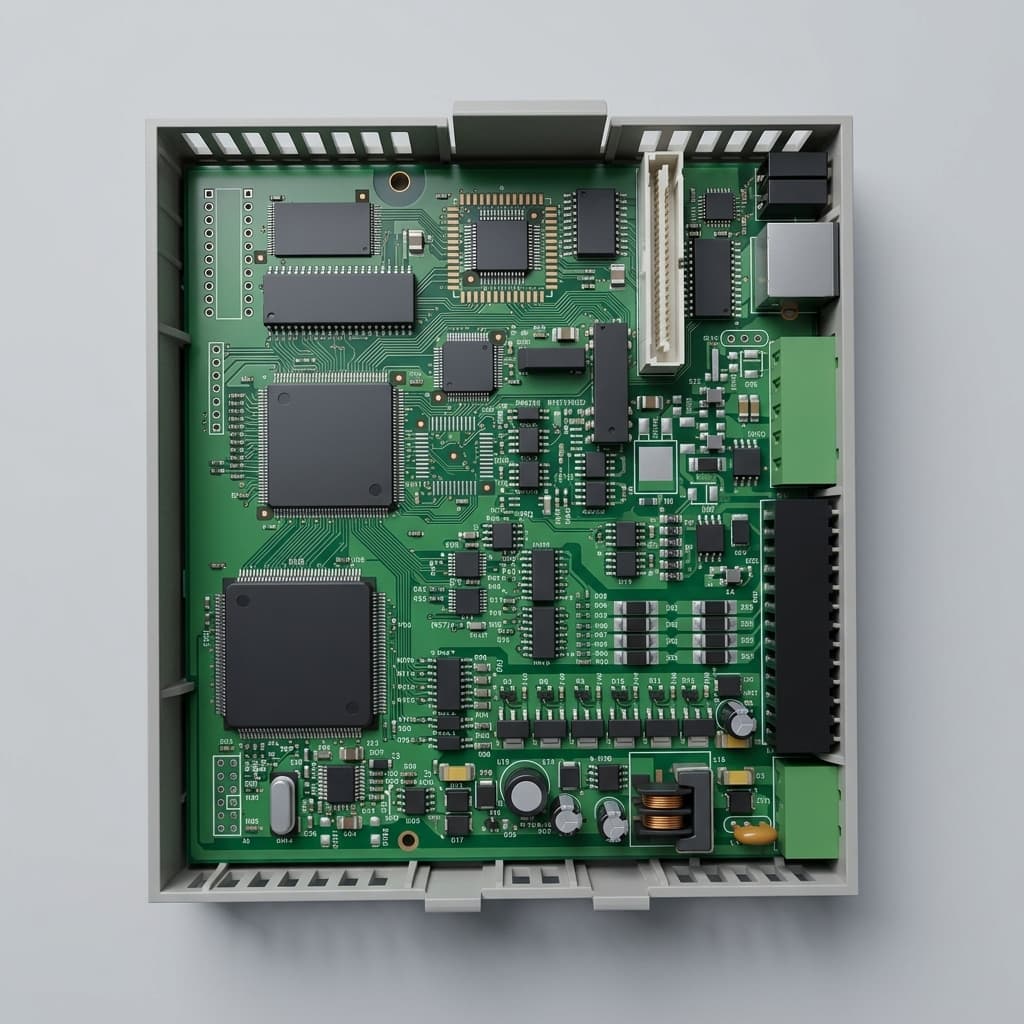
Driver-encoder integrated servo board PCBA stack combining FOC drive and absolute encoder on a single compact module

Overview

The driver-encoder integrated servo board combines a high-performance FOC servo drive and a high-resolution absolute magnetic encoder onto a single compact PCBA stack, eliminating the separate encoder cable and reducing the total axial length of robotic joint actuator modules. This 2-in-1 architecture is particularly valuable for frameless torque motor integrations where every millimeter of axial space directly affects the robot's joint envelope and overall kinematic reach. By co-locating the encoder sensor with the drive electronics, the integrated board also removes a common failure point in robotic joints: the encoder cable and connector, which can be damaged by vibration, routing stress, or assembly errors during joint production. The encoder section typically supports absolute magnetic sensing via BiSS-C, SSI, or SPI interfaces, with resolution options up to 19-bit or higher depending on the encoder IC selection. A critical engineering consideration that buyers often underestimate is thermal isolation between the power stage and the encoder chip. GaN or MOSFET switching generates localized heat that can bias precision magnetic encoder readings if the PCB layout does not include adequate thermal isolation planes and proper magnet-to-sensor air gap control. Our integration review therefore includes magnet geometry, concentricity tolerance stack-up, and thermal gradient analysis before finalizing the board layout for a specific joint module application.

Capability Highlights

  • Eliminates motor-to-drive encoder cables
  • Dual-loop control ready (motor position + output position)
  • Onboard BiSS-C / SSI processing

Typical Applications

  • Frameless Motor Integration
  • Humanoid Actuators

Engineering Focus

  • Magnet gap and concentricity tolerances
  • Thermal isolation between drive FETs and encoder chip

Specification Snapshot

Use these buyer-side parameters to decide whether this page matches your architecture before starting a formal quotation thread.

ParameterTypical DirectionBuyer Note
ArchitectureServo drive plus absolute encoder on a compact stackBest for teams trying to remove encoder harnesses and reduce actuator axial length.
Encoder interfacesBiSS-C, SSI, SPI, ABI, UVW, Hall, or custom feedbackShare magnet geometry, air gap, concentricity tolerance, and output-side feedback needs.
Mechanical targetDisk, annular, or custom-outline PCB optionsOuter diameter, inner diameter, stack height, and mounting holes drive layout feasibility.
Control modeDual-loop and current-control tuning optionsClarify whether output encoder feedback is required for reducer backlash compensation.

Selection Logic Before RFQ

Use this flow to decide whether the page is a practical match before comparing unit price or sample lead time.

CheckpointDecision InputBuyer Action
1. Confirm buyer fitJoint module designers aiming to minimize axial length and harness complexity.Use this page when the project involves Frameless Motor Integration, Humanoid Actuators.
2. Define operating windowArchitecture: Servo drive plus absolute encoder on a compact stackBest for teams trying to remove encoder harnesses and reduce actuator axial length.
3. Lock integration constraintsEncoder interfaces: BiSS-C, SSI, SPI, ABI, UVW, Hall, or custom feedbackConvert Magnet gap and concentricity tolerances, Thermal isolation between drive FETs and encoder chip into measurable RFQ values before asking for final pricing.
4. Gate sample approvalEncoder calibration report and Thermal isolation and EMI layout notesRequest this evidence with the sample or pilot quote so acceptance criteria are clear before PO.

Buyer Decision Notes

  • Use this family when separate drive and encoder boards create too much axial length or wiring risk.
  • Confirm encoder thermal isolation because GaN power-stage heat can bias precision feedback.
  • Request a magnet and encoder tolerance stack before freezing the joint mechanical design.

Factory & Delivery Capability

  • Encoder IC, magnet, and PCB stack-up coordination for compact actuator modules.
  • Fixture-based encoder calibration and end-of-line feedback checks.
  • Harness reduction and connector consolidation for assembly-friendly joint modules.

Key Evaluation Matrix

MetricTypical RangeWhy It Matters
Axial Thickness< 15mmDirectly dictates the total length of the robotic joint module.

RFQ Preparation Checklist

  1. Motor pole pair count
  2. Required encoder resolution (e.g., 19-bit)
  3. Hollow shaft diameter requirements

Risk and Mitigation

  • Magnetic interference from phase wires: Shielded plane design in PCBA and careful phase wire routing guidelines.

Validation Evidence to Request

EvidenceWhy It Matters
Encoder calibration reportShows offset, repeatability, and feedback stability before the board is built into a joint.
Thermal isolation and EMI layout notesReduces the risk of phase-wire noise or power-stage heat degrading encoder readings.

Production, QC, and Delivery Flow

Treat the flow below as a minimum evidence path from inquiry to pilot release. It keeps engineering, quality, and purchasing aligned before a repeat order.

StageWhat to CheckEvidence / Output
1. Requirement triageMotor pole pair count, Required encoder resolution (e.g., 19-bit), Hollow shaft diameter requirementsFit/no-fit direction, missing data list, and closest standard or semi-custom platform.
2. Sample configurationMagnet gap and concentricity tolerances, Thermal isolation between drive FETs and encoder chipMotor, encoder, firmware, connector, and cooling assumptions tied to a sample revision.
3. Bench and thermal validationEncoder calibration reportShows offset, repeatability, and feedback stability before the board is built into a joint.
4. Pilot releaseEOL records, firmware baseline, protection behavior, and packaging methodPilot-lot evidence package before production forecast and repeat order.

RFQ Starter

For a driver-encoder integrated board review, send motor geometry, pole pairs, magnet and encoder requirements, OD/ID, stack height, protocol, and dual-loop expectations.

Open Contact / RFQ Checklist

Buyer FAQ

Which encoder chips are supported?

We typically integrate IC-Haus or AMS absolute magnetic encoders depending on availability and accuracy requirements.

What data should we send for Driver-Encoder Integrated Servo Board?

For a driver-encoder integrated board review, send motor geometry, pole pairs, magnet and encoder requirements, OD/ID, stack height, protocol, and dual-loop expectations.

How should Driver-Encoder Integrated Servo Board be validated before pilot build?

Request Encoder calibration report. Shows offset, repeatability, and feedback stability before the board is built into a joint.

When is Driver-Encoder Integrated Servo Board the right page to review?

It is a better fit when the project needs robotics-grade current control, encoder feedback, protection behavior, and compact packaging instead of a generic hobby controller. A good first screen is architecture: Servo drive plus absolute encoder on a compact stack.

Recommended Next Pages

  • Robot joint servo drive
  • Humanoid robot joints
  • Frameless motor integration guide
  • Contact / RFQ

Engineering RFQ

Request an evaluation kit or custom BOM estimate.

Send motor, encoder, voltage, current, protocol, board envelope, and quantity-stage specs to [email protected] or WhatsApp +86 18857971991 for an engineering review.

Request Evaluation KitRequest Custom BOM Estimate