
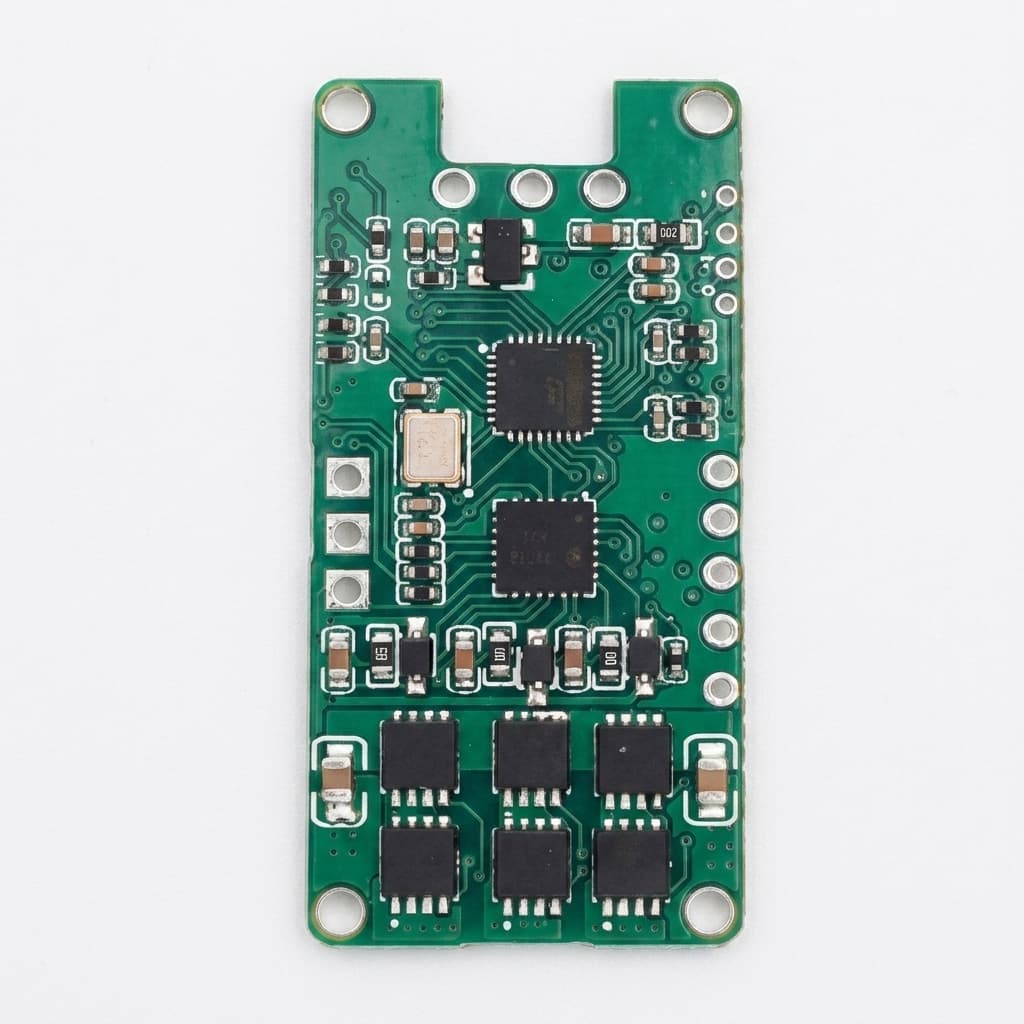
Overview
Robot joint servo drives are disk-shaped or annular PCBA modules specifically designed to mount flush against frameless torque motors inside robotic joint actuator housings. Unlike rectangular or DIN-rail servo drives intended for industrial cabinets, a robot joint servo drive is shaped to maximize the use of cylindrical space inside a joint module while maintaining thermal conduction paths to the outer aluminum housing. The circular form factor allows the inner diameter (ID) to serve as a cable pass-through for power, communication, and sensor lines that route through the center of rotation, which is essential for multi-DOF robot arms where external cable loops cause reliability and aesthetic issues. Key design parameters that determine whether a robot joint servo drive fits a specific actuator include the outer diameter (OD), inner diameter (ID), stack height, mounting hole pattern, connector height and exit direction, and thermal contact area with the housing. Our standard platforms cover OD ranges from approximately 40mm to 90mm, but custom layouts can be developed for specific OEM joint housing designs. The thermal management strategy is particularly important: in a sealed joint cavity with no active airflow, the drive relies entirely on conduction cooling through the PCB mounting surface to the aluminum housing. Buyers should share their housing material, thermal pad plan, ambient temperature range, and worst-case duty cycle profile so that derating analysis can be performed before sample production.