
Discuss EtherCAT/CAN FD requirements, sample availability, and lead-time assumptions.

GaN Servo Drives LogoGaN Servo Drives
Request RFQ
GaN Servo Drives LogoGaN Servo Drives

High-performance GaN servo drives and motion electronics manufactured in Shenzhen & Dongguan.

Inquiry Email

[email protected]

Email app

Include voltage, current, motor, encoder, protocol, board envelope, and quantity stage.

Instant Chat

+86 18857971991

Chat on WhatsApp

Direct response from our engineering team.

Products
  • GaN Low-Voltage Servo Drives
  • 48V Servo Driver Board
  • Driver-Encoder Integrated Servo Board
  • Robot Joint Servo Drive
  • EtherCAT 48V Servo Drive
  • CAN FD Servo Drive
Solutions
  • Humanoid Robot Joints
  • Collaborative Robot (Cobot) Joints
  • AMR and Mobile Robot Servo Drives
  • Exoskeleton and Prosthetics Servo Drives
  • GaN Servo Drive Selection Guide
  • EtherCAT & CAN FD Integration
OEM Capabilities
  • OEM Robot Joint BOM & Customization
  • Rigorous Compliance & Quality Control
  • Deep OEM Custom Solutions
  • Engineering File Request Center & CAD Resources
Resources
  • Blog
  • Factory
  • Contact / RFQ
  • Privacy Policy
  • Cookie Policy
  • Terms of Service
© 2026 GaN Servo Drives. All Rights Reserved.|Backed by Linkup Ai Co., Ltd. Manufacturing delivered by the Advanced Manufacturing Division of Linkup Precision.|Legal entity: Linkup Ai Co., Ltd.
← Back to Products

Hollow Shaft Integrated Joints

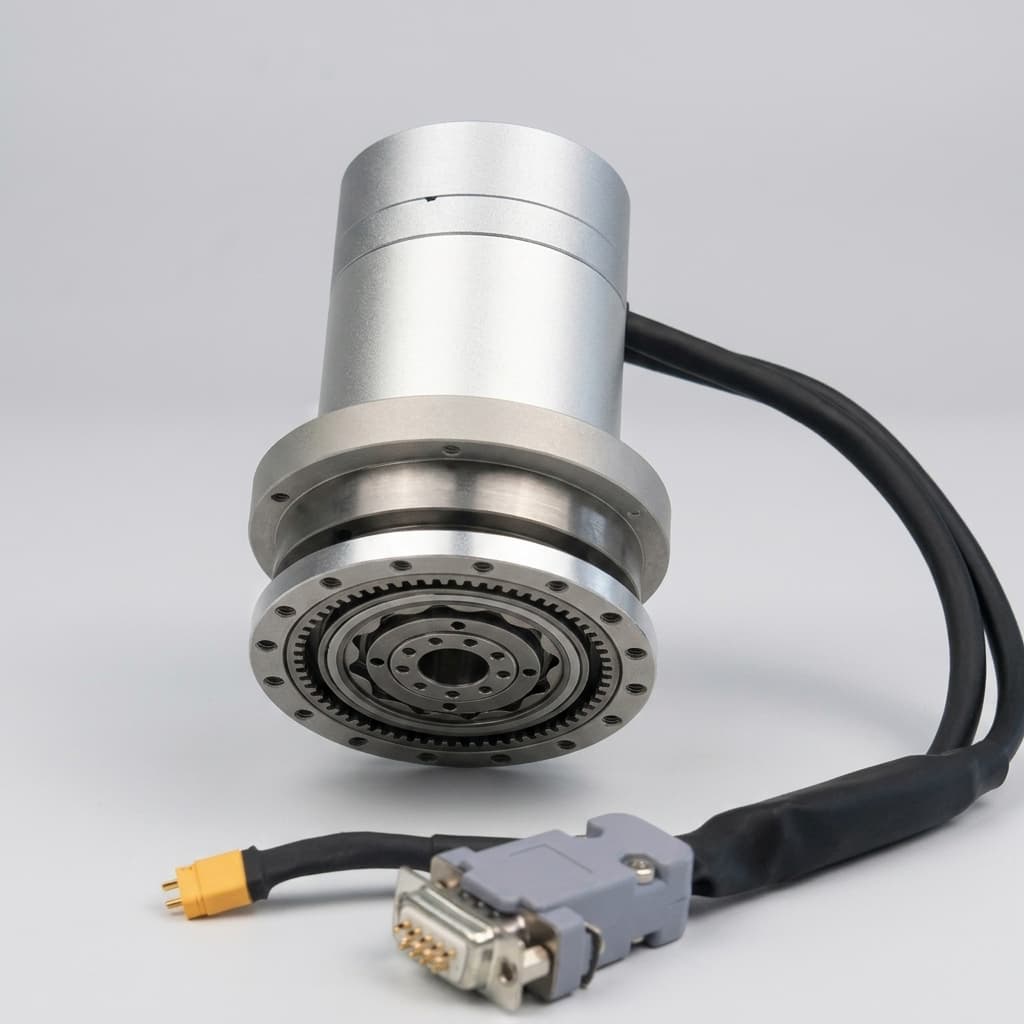
All-in-one robotic joint actuators featuring an embedded GaN drive, frameless motor, dual absolute encoders, and harmonic reducer in a large-bore hollow shaft design.

Target Buyer:Robotics startups and OEMs seeking integrated joint modules with defined validation and fit checks.
Hollow Shaft Integrated Joints

Overview

Hollow shaft integrated joint modules are complete electromechanical actuator assemblies that combine a GaN servo drive board, frameless torque motor, dual absolute encoders, harmonic or planetary gear reducer, electromagnetic brake, and CNC-machined aluminum housing into a single ready-to-mount unit with a large-bore hollow center shaft for internal cable routing. This all-in-one architecture eliminates the need for robotics teams to separately source, qualify, and integrate six or more precision components — a process that typically requires 3 to 6 months of mechanical and electrical engineering iteration. The hollow shaft design, with typical bore diameters of 20mm or larger, allows power cables, EtherCAT or CAN communication lines, and sensor wiring to route through the center of rotation, eliminating external cable loops that cause reliability problems and limit the joint's continuous rotation range. Integrated joint modules are the strongest fit for robotics startups and OEMs that want to accelerate time-to-prototype by receiving a validated actuator unit rather than assembling individual components on their own production line. However, buyers should understand that the commercial terms and engineering evidence requirements change significantly between a prototype sample (1-5 units for lab validation) and a production-ready module (pilot batches of 50+ units with serialized quality records). Our team coordinates the full BOM — drive electronics, motor winding, encoder calibration, reducer inspection, brake testing, and housing machining — through China-based manufacturing partners, providing a single point of contact for the entire actuator stack.

Capability Highlights

  • Fully integrated electromechanical actuator
  • Large 20mm+ hollow shaft for cable routing
  • Zero-backlash harmonic gearing

Typical Applications

  • Cobots
  • Humanoid Arms
  • Surgical Manipulators

Engineering Focus

  • Output torque and speed trade-offs
  • Structural rigidity and payload capacity

Specification Snapshot

Use these buyer-side parameters to decide whether this page matches your architecture before starting a formal quotation thread.

ParameterTypical DirectionBuyer Note
Delivered scopeDrive, frameless motor, encoder, reducer, brake, and housingUse this when the project needs a joint module, not only a servo drive board.
Hollow shaftLarge-bore routing for power, EtherCAT/CAN, and sensor linesDefine pass-through diameter and bend radius before gearbox and housing selection.
Torque windowRated and peak torque configured by motor and reducer familyShare payload, link length, motion profile, and peak duration for realistic sizing.
Integration levelPrototype actuator, pilot module, or production-ready jointCommercial terms change significantly between sample builds and repeat production.

Selection Logic Before RFQ

Use this flow to decide whether the page is a practical match before comparing unit price or sample lead time.

CheckpointDecision InputBuyer Action
1. Confirm buyer fitRobotics startups and OEMs seeking integrated joint modules with defined validation and fit checks.Use this page when the project involves Cobots, Humanoid Arms, Surgical Manipulators.
2. Define operating windowDelivered scope: Drive, frameless motor, encoder, reducer, brake, and housingUse this when the project needs a joint module, not only a servo drive board.
3. Lock integration constraintsHollow shaft: Large-bore routing for power, EtherCAT/CAN, and sensor linesConvert Output torque and speed trade-offs, Structural rigidity and payload capacity into measurable RFQ values before asking for final pricing.
4. Gate sample approvalTorque-speed and thermal test summary and FAI and serialized outgoing inspection recordsRequest this evidence with the sample or pilot quote so acceptance criteria are clear before PO.

Buyer Decision Notes

  • Choose this path when your team wants to reduce mechanical, electrical, and firmware integration burden.
  • Ask for torque-speed assumptions, reducer lifetime notes, and cable-routing drawings together.
  • Plan a first article inspection stage before using the module in a full robot build.

Factory & Delivery Capability

  • Joint actuator assembly using frameless motor, harmonic or planetary reducer, brake, encoder, and drive electronics.
  • CNC housing, shaft, cable routing, and mounting-interface coordination.
  • Pilot-batch control with serial tracking, firmware baselines, and outgoing inspection records.

Key Evaluation Matrix

MetricTypical RangeWhy It Matters
Torque DensityHigh (varies by gear ratio)Determines the payload capacity of the robot arm relative to its weight.

RFQ Preparation Checklist

  1. Target rated & peak torque (Nm)
  2. Output speed (RPM)
  3. Hollow shaft diameter needed

Risk and Mitigation

  • Gearbox wear / backlash over time: We utilize premium harmonic reducers with rigorous lifetime testing data.

Validation Evidence to Request

EvidenceWhy It Matters
Torque-speed and thermal test summaryShows whether the integrated joint matches the robot motion profile before batch sourcing.
FAI and serialized outgoing inspection recordsGives procurement and quality teams evidence for pilot-lot release.

Production, QC, and Delivery Flow

Treat the flow below as a minimum evidence path from inquiry to pilot release. It keeps engineering, quality, and purchasing aligned before a repeat order.

StageWhat to CheckEvidence / Output
1. Requirement triageTarget rated & peak torque (Nm), Output speed (RPM), Hollow shaft diameter neededFit/no-fit direction, missing data list, and closest standard or semi-custom platform.
2. Sample configurationOutput torque and speed trade-offs, Structural rigidity and payload capacityMotor, encoder, firmware, connector, and cooling assumptions tied to a sample revision.
3. Bench and thermal validationTorque-speed and thermal test summaryShows whether the integrated joint matches the robot motion profile before batch sourcing.
4. Pilot releaseEOL records, firmware baseline, protection behavior, and packaging methodPilot-lot evidence package before production forecast and repeat order.

RFQ Starter

For a hollow shaft joint review, send rated and peak torque, output speed, pass-through diameter, motor/reducer preference, brake needs, bus protocol, and target robot axis.

Open Contact / RFQ Checklist

Buyer FAQ

What is the advantage of the hollow shaft?

It can route power, EtherCAT/CAN, and sensor lines through the center of rotation, reducing external cable loops when the joint architecture supports internal routing.

What data should we send for Hollow Shaft Integrated Joints?

For a hollow shaft joint review, send rated and peak torque, output speed, pass-through diameter, motor/reducer preference, brake needs, bus protocol, and target robot axis.

How should Hollow Shaft Integrated Joints be validated before pilot build?

Request Torque-speed and thermal test summary. Shows whether the integrated joint matches the robot motion profile before batch sourcing.

When is Hollow Shaft Integrated Joints the right page to review?

It is a better fit when the project needs robotics-grade current control, encoder feedback, protection behavior, and compact packaging instead of a generic hobby controller. A good first screen is delivered scope: Drive, frameless motor, encoder, reducer, brake, and housing.

Recommended Next Pages

  • OEM robot joint BOM
  • Frameless motor integration guide
  • Factory profile
  • Contact / RFQ

Engineering RFQ

Request an evaluation kit or custom BOM estimate.

Send motor, encoder, voltage, current, protocol, board envelope, and quantity-stage specs to [email protected] or WhatsApp +86 18857971991 for an engineering review.

Request Evaluation KitRequest Custom BOM Estimate