
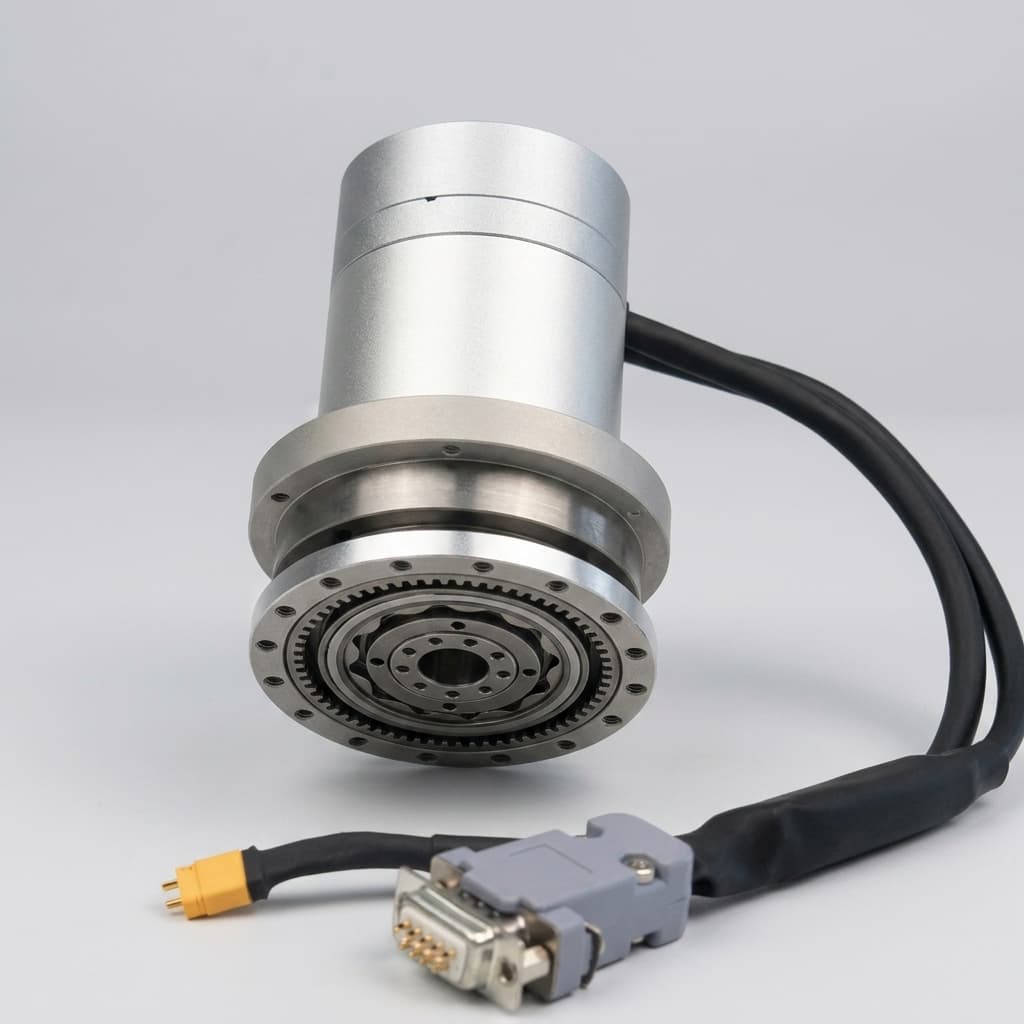
Frameless Motor Integration: Sourcing Guide for Hollow Shaft Servo Drives
The shift from housed servo motors to integrated frameless joint modules is changing how compact robots are built. By embedding the motor rotor and stator directly into the robot's mechanical structure, OEMs can improve torque-to-weight ratio when the bearing, encoder, housing, and thermal paths are designed together.
TL;DR (Executive Summary):
- Frameless integration: Can reduce redundant structure and improve torque density when mechanical tolerances and assembly process are controlled.
- Dual-loop phasing: High-stiffness precision may require both an inner rotor encoder and an outer load encoder to compensate for reducer deflection.
- Thermal pathing: Compact servo drives should be reviewed with the joint housing, thermal interface, and continuous-current target before the PCB envelope is frozen.
Anatomy of a Hollow-Shaft Joint
When transitioning from off-the-shelf housed servomotors to custom hollow-shaft joint modules, the mechanical and electrical integration complexity increases quickly.
Integrating a frameless BLDC motor requires the OEM to take on the responsibilities of a motor manufacturer: maintaining air gaps, designing bearing structures, handling encoder alignment, and—most critically—embedding the servo drive electronics securely within the housing.
The Physical Stack
A typical integrated joint follows a highly stacked pancake architecture. From front to back:
Notice how the GaN Servo Drive PCB (Layer 5) sits at the back. It must pass the hollow bore (for internal cable routing) while simultaneously managing connections to the stator phases, the encoder, and the external bus network.
The Dual-Encoder Challenge
To compensate for the flexibility of the strain wave gear (harmonic drive) and improve high-stiffness position control, many advanced joints use Dual Loop Control. This requires:
- Inner Loop Encoder: Mounted on the motor rotor (high speed, before the gear reduction).
- Outer Loop Encoder: Mounted on the joint output flange (low speed, absolute position after reduction).
When selecting a servo drive PCB, confirm whether it supports the required inner and outer encoder interfaces, such as BiSS-C, SSI, SPI, ABI, or another protocol.
Dual-Loop Phasing (C++ Control Logic)
The complexity of dual-loop control lies in aligning the high-speed rotor angle with the low-speed load angle. Below is a conceptual C++ snippet showing one way encoder phasing can be handled during startup:
void JointController::calibrateDualEncoders() {
    // 1. Read absolute positions
    float rotorAngle = innerEncoder.readAngle(); // Before gear (e.g., 0-360 deg)
    float loadAngle = outerEncoder.readAngle();  // After gear (e.g., 0-360 deg)

    // 2. Map rotor angle to load domain using gear ratio (e.g., 100:1)
    float mappedRotorAngle = rotorAngle / GEAR_RATIO;

    // 3. Calculate structural deflection (wind-up)
    float structuralDeflection = loadAngle - mappedRotorAngle;

    // 4. Feed deflection into the position PI compensator
    if (abs(structuralDeflection) > MAX_SAFE_DEFLECTION) {
        triggerFault(ERR_HARMONIC_DRIVE_SLIP);
    } else {
        updateFeedforwardTorque(structuralDeflection * STIFFNESS_CONSTANT);
    }
}
If your electronics supplier only offers single-encoder drives, you may need to calculate this deflection at the IPC master level or change the control architecture. That tradeoff should be reviewed against your bus cycle time and stiffness target.
Thermal Pathing: Sinking the Stator and Drive
In a housed motor, the manufacturer handles heat dissipation. In a frameless module, the OEM must design the thermal paths. The two primary heat sources are:
- The Stator Copper Losses (I²R).
- The Servo Drive Switching and Conduction Losses.
Best practice: Do not thermally isolate the PCB unless the design has another validated heat path. The back casing of the robot joint can act as a shared thermal mass, but the interface material, contact pressure, insulation, and service temperature must be checked for the quoted drive revision.
Procurement Checklist for Frameless Joint Drives
Before submitting an RFQ for joint drives, ensure you have defined the following:
- Inner Bore Diameter: What is the minimum ID required for your slip ring or cable routing?
- Outer Diameter Limit: What is the max OD of the PCB that fits inside your casing?
- Bus Voltage: (e.g., 48V nominal).
- Continuous Current: Based on the continuous holding torque of the joint.
- Protocol: EtherCAT, CAN FD, or RS485?
- Encoder Interfaces: BiSS-C, Tamagawa, or Incremental?
OEM Lead Time and Lifecycle Management
When sourcing hollow-shaft electronics, standard catalog models rarely fit a joint housing without review. Many programs require a semi-custom PCBA or connector change, so the supplier's engineering process is as important as the drive's headline specs. Ask your electronics partner:
- NRE (Non-Recurring Engineering) Costs: What engineering fee applies to PCB outline, mounting-hole, connector, or firmware changes?
- First Article Inspection (FAI): What is the lead-time assumption from design freeze to delivering the first working prototypes, and which records are included?
- EOL (End of Life) Planning: Can they provide BOM lock, change notifications, and form-fit-function replacement planning for the expected product lifecycle?
Conclusion: Accelerating Your Actuator Design
Building a reliable frameless joint requires tight coordination between mechanical constraints and electrical performance. By locking in your PCB envelope early and designing for encoder phasing and thermal sinking, you reduce costly redesigns late in the prototyping phase.
Ready to start prototyping? Explore our Custom OEM Servo Solutions for tailored PCB form factors, or review our OEM Robot Joint BOM support and Engineering File Requests for hollow-shaft drive dimensions. For high-speed networking, see our article on EtherCAT vs CAN FD.
Author

Categories
More Posts
Evaluating Monolithic 3-Phase GaN Servo Micromodules: 2026 Procurement & Engineering Guide
A 2026 engineering and procurement guide to monolithic 3-phase GaN servo micromodules, thermal limits, supplier risk, sourcing checklist, and fit for compact robotics.
How to Select a 48V EtherCAT Servo Drive for Humanoid Robot Joints
Evaluating SIL3 STO in Micro GaN Servo Drives: A Procurement and Compliance Guide
Evaluate SIL3 STO in micro GaN servo drives globally: compare isolation, CMTI, certification evidence, supplier risks, and RFQ checks. Request review.