
Discuss EtherCAT/CAN FD requirements, sample availability, and lead-time assumptions.

GaN Servo Drives LogoGaN Servo Drives
Request RFQ
GaN Servo Drives LogoGaN Servo Drives

High-performance GaN servo drives and motion electronics manufactured in Shenzhen & Dongguan.

Inquiry Email

[email protected]

Email app

Include voltage, current, motor, encoder, protocol, board envelope, and quantity stage.

Instant Chat

+86 18857971991

Chat on WhatsApp

Direct response from our engineering team.

Products
  • GaN Low-Voltage Servo Drives
  • 48V Servo Driver Board
  • Driver-Encoder Integrated Servo Board
  • Robot Joint Servo Drive
  • EtherCAT 48V Servo Drive
  • CAN FD Servo Drive
Solutions
  • Humanoid Robot Joints
  • Collaborative Robot (Cobot) Joints
  • AMR and Mobile Robot Servo Drives
  • Exoskeleton and Prosthetics Servo Drives
  • GaN Servo Drive Selection Guide
  • EtherCAT & CAN FD Integration
OEM Capabilities
  • OEM Robot Joint BOM & Customization
  • Rigorous Compliance & Quality Control
  • Deep OEM Custom Solutions
  • Engineering File Request Center & CAD Resources
Resources
  • Blog
  • Factory
  • Contact / RFQ
  • Privacy Policy
  • Cookie Policy
  • Terms of Service
© 2026 GaN Servo Drives. All Rights Reserved.|Backed by Linkup Ai Co., Ltd. Manufacturing delivered by the Advanced Manufacturing Division of Linkup Precision.|Legal entity: Linkup Ai Co., Ltd.
← Back to Products

EtherCAT 48V Servo Drive

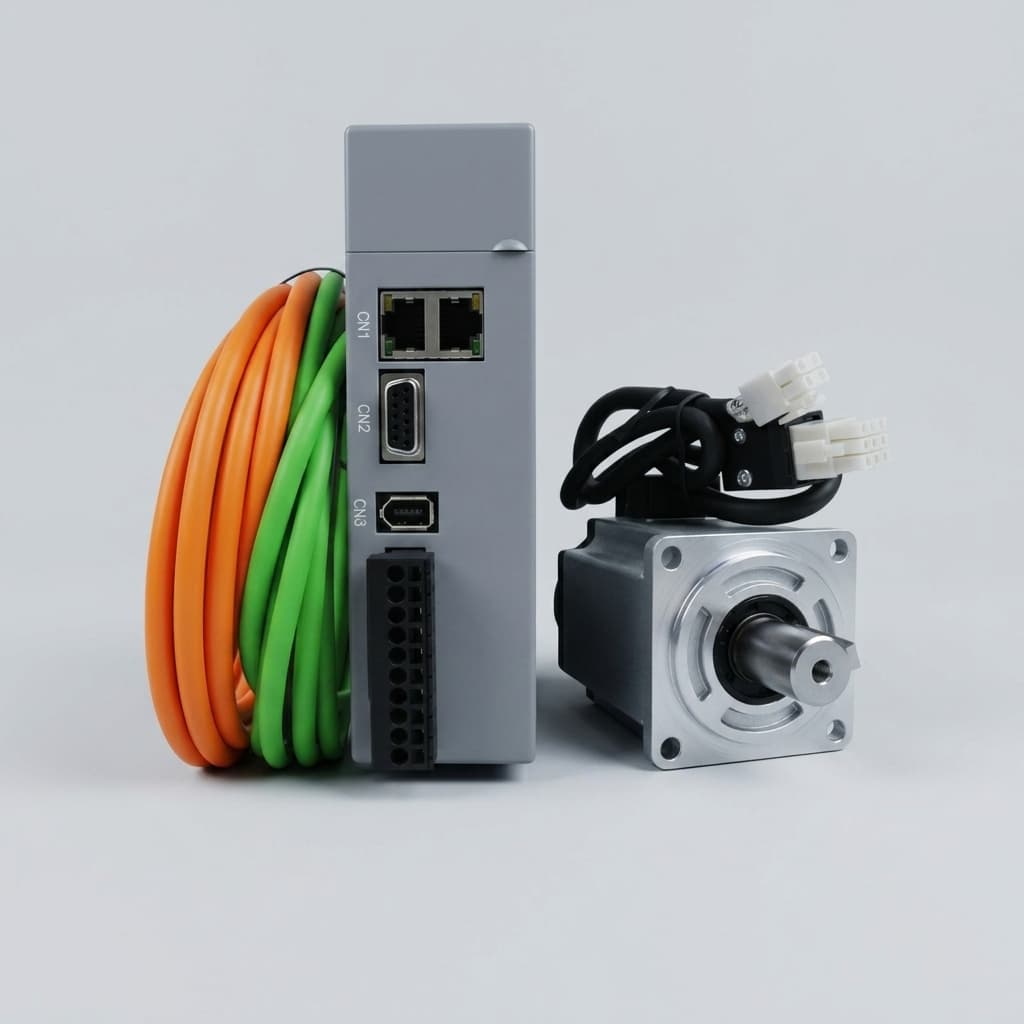
EtherCAT servo drives for deterministic, multi-axis synchronous control in industrial and robotic networks, with CiA 402 behavior confirmed per firmware package.

Target Buyer:Control systems engineers building real-time deterministic networks.
EtherCAT 48V Servo Drive

Overview

EtherCAT 48V servo drives enable deterministic, sub-millisecond synchronized multi-axis control for advanced robotic systems where multiple joint actuators must move in precisely coordinated trajectories. EtherCAT's wire-level synchronization via Distributed Clocks (DC) makes it the preferred fieldbus for high-DOF humanoid robots, collaborative robot arms, and synchronized actuator test benches where control loop timing directly affects motion quality and safety. Our EtherCAT servo drives implement the CiA 402 device profile for compatibility with standard motion control masters including Beckhoff TwinCAT 3, IgH EtherCAT Master (Linux), SOEM, and ROS2-based robot controllers. The drives support Cyclic Synchronous Position (CSP), Cyclic Synchronous Velocity (CSV), and Cyclic Synchronous Torque (CST) operating modes with configurable PDO mapping for application-specific data exchange. Minimum achievable cycle times are typically 125 µs to 250 µs depending on the axis count, PDO size, and master stack implementation. A critical procurement step that many robotics teams overlook is verifying master compatibility before ordering hardware samples. The ESI (EtherCAT Slave Information) XML file, object dictionary, and firmware version must be revision-matched between the drive and the buyer's master controller to avoid integration delays. We recommend requesting these commissioning files at the RFQ stage, not after hardware arrives, so controls engineers can validate the PDO mapping and object dictionary structure in their development environment before the physical sample integration begins.

Capability Highlights

  • Native EtherCAT (Beckhoff ET1100/AX58100)
  • Distributed Clocks (DC) support reviewed against target cycle time
  • CSP, CSV, CST mode support

Typical Applications

  • High-DOF humanoid robots
  • Collaborative robot arms
  • Synchronized multi-axis actuator benches

Engineering Focus

  • TwinCAT 3 / ROS2 hardware integration
  • PDO mapping and update rates

Specification Snapshot

Use these buyer-side parameters to decide whether this page matches your architecture before starting a formal quotation thread.

ParameterTypical DirectionBuyer Note
NetworkEtherCAT with CiA 402 style commissioningConfirm master stack, cycle time, PDO mapping, and distributed-clock needs before sample order.
Voltage platform48V nominal, low-voltage battery and lab systemsShare bus limits, regeneration strategy, and braking requirements for multi-axis robots.
Motion modesCSP, CSV, CST, homing, diagnostics, and parameter storageList the exact modes your controller expects so ESI and firmware can be checked.
Commissioning filesESI XML, object dictionary, and test notesAsk which files exist for the quoted revision during RFQ, not after hardware arrives.

Selection Logic Before RFQ

Use this flow to decide whether the page is a practical match before comparing unit price or sample lead time.

CheckpointDecision InputBuyer Action
1. Confirm buyer fitControl systems engineers building real-time deterministic networks.Use this page when the project involves High-DOF humanoid robots, Collaborative robot arms, Synchronized multi-axis actuator benches.
2. Define operating windowNetwork: EtherCAT with CiA 402 style commissioningConfirm master stack, cycle time, PDO mapping, and distributed-clock needs before sample order.
3. Lock integration constraintsVoltage platform: 48V nominal, low-voltage battery and lab systemsConvert TwinCAT 3 / ROS2 hardware integration, PDO mapping and update rates into measurable RFQ values before asking for final pricing.
4. Gate sample approvalESI XML and PDO mapping sheet and Cycle-time and jitter validation notesRequest this evidence with the sample or pilot quote so acceptance criteria are clear before PO.

Buyer Decision Notes

  • Choose EtherCAT when synchronized multi-axis control is more important than minimum electronics cost.
  • Ask for master compatibility notes against TwinCAT, IgH, SOEM, or your robot controller.
  • Lock firmware and ESI file revisions as part of sample acceptance.

Factory & Delivery Capability

  • Firmware configuration and ESI file preparation for OEM EtherCAT networks.
  • Bench testing against standard EtherCAT masters and multi-axis topology assumptions.
  • Shielding, connector, and harness support for noisy robot joint environments.

Key Evaluation Matrix

MetricTypical RangeWhy It Matters
Min Cycle Time125 µs - 250 µsEssential for high-speed impedance control in robotics.

RFQ Preparation Checklist

  1. Cycle time requirements (e.g., 250us, 1ms)
  2. Preferred EtherCAT master (TwinCAT, IgH, SOEM)

Risk and Mitigation

  • Master compatibility issues: Request ESI files and master compatibility notes for the exact firmware revision.

Validation Evidence to Request

EvidenceWhy It Matters
ESI XML and PDO mapping sheetLets controls engineers verify object mapping before integrating the sample when revision-matched files are available.
Cycle-time and jitter validation notesConfirms whether the proposed drive can support high-DOF synchronized motion.

Production, QC, and Delivery Flow

Treat the flow below as a minimum evidence path from inquiry to pilot release. It keeps engineering, quality, and purchasing aligned before a repeat order.

StageWhat to CheckEvidence / Output
1. Requirement triageCycle time requirements (e.g., 250us, 1ms), Preferred EtherCAT master (TwinCAT, IgH, SOEM)Fit/no-fit direction, missing data list, and closest standard or semi-custom platform.
2. Sample configurationTwinCAT 3 / ROS2 hardware integration, PDO mapping and update ratesMotor, encoder, firmware, connector, and cooling assumptions tied to a sample revision.
3. Bench and thermal validationESI XML and PDO mapping sheetLets controls engineers verify object mapping before integrating the sample when revision-matched files are available.
4. Pilot releaseEOL records, firmware baseline, protection behavior, and packaging methodPilot-lot evidence package before production forecast and repeat order.

RFQ Starter

For an EtherCAT 48V servo drive review, send master controller, target cycle time, operating mode, PDO needs, axis count, bus voltage, current, encoder, and ESI expectations.

Open Contact / RFQ Checklist

Buyer FAQ

Do you provide ESI files?

ESI files can be provided for standard EtherCAT drive revisions. Confirm the XML, object dictionary, and firmware version during RFQ.

What data should we send for EtherCAT 48V Servo Drive?

For an EtherCAT 48V servo drive review, send master controller, target cycle time, operating mode, PDO needs, axis count, bus voltage, current, encoder, and ESI expectations.

How should EtherCAT 48V Servo Drive be validated before pilot build?

Request ESI XML and PDO mapping sheet. Lets controls engineers verify object mapping before integrating the sample when revision-matched files are available.

When is EtherCAT 48V Servo Drive the right page to review?

It is a better fit when the project needs robotics-grade current control, encoder feedback, protection behavior, and compact packaging instead of a generic hobby controller. A good first screen is network: EtherCAT with CiA 402 style commissioning.

Recommended Next Pages

  • EtherCAT Integration Guide
  • Humanoid robot EtherCAT guide
  • Quality controls
  • Contact / RFQ

Engineering RFQ

Request an evaluation kit or custom BOM estimate.

Send motor, encoder, voltage, current, protocol, board envelope, and quantity-stage specs to [email protected] or WhatsApp +86 18857971991 for an engineering review.

Request Evaluation KitRequest Custom BOM Estimate