
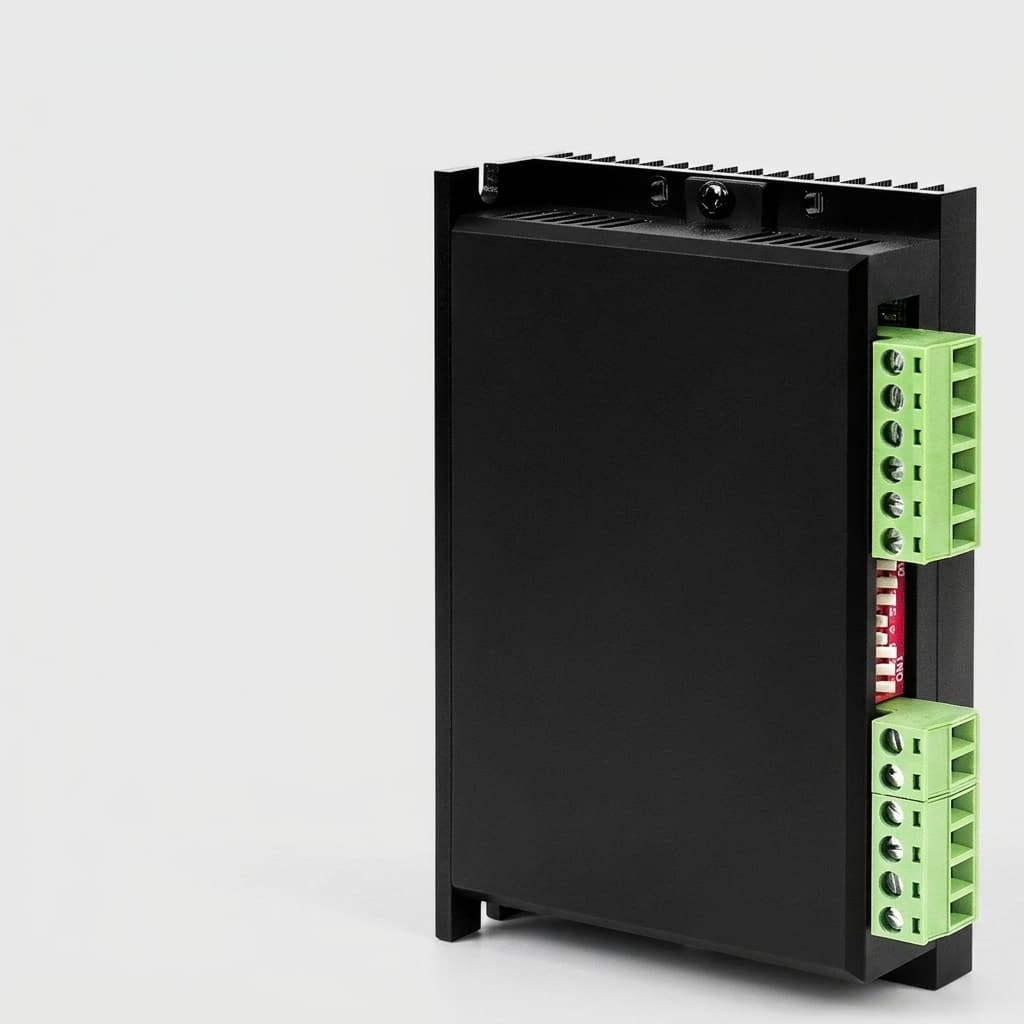
Sourcing Decentralized IP67 GaN Servo Drives: Wiring Cost Reduction and Thermal Trade-offs
Global sourcing guide for decentralized IP67 GaN servo drives, covering wiring cost models, thermal derating limits, RFQ evidence, and OEM sourcing CTAs.
The industrial automation landscape is undergoing a massive architectural shift, and GaN servo drive sourcing now sits directly in the middle of that decision. For decades, machine builders have relied on centralized control cabinets—massive, air-conditioned steel enclosures housing dozens of servo drives, PLCs, and contactors. Power and feedback cables were then routed, sometimes over dozens of meters, to individual motors on the machine. Today, the demand for modular, scalable, and footprint-free machines is driving the transition toward "zero-cabinet" designs. At the heart of this transition is the decentralized IP67 servo drive.
However, moving a servo drive out of the climate-controlled cabinet and bolting it directly onto a machine chassis exposes it to harsh environmental conditions: liquid washdowns, metallic dust, and intense vibration. To survive, these drives must be sealed in an IP67 or IP69K enclosure. This introduces a severe engineering bottleneck—thermal management. Traditional Silicon (Si) based drives generate significant switching heat, requiring bulky heat sinks that defeat the purpose of compact decentralization.
Enter Gallium Nitride (GaN). GaN High Electron Mobility Transistors (HEMTs) fundamentally change the thermal equation, making ultra-compact, high-power-density IP67 drives a reality. In this comprehensive guide, we will explore the engineering trade-offs, wiring cost reductions, application boundaries, and critical sourcing strategies for decentralized IP67 GaN servo drives. Whether you are an automation engineer designing a new packaging line, or a procurement manager seeking to lower Total Cost of Ownership (TCO), this guide provides the necessary frameworks for your next generation of motion control.
TL;DR (Executive Summary):
- The Thermal Advantage: GaN HEMTs dramatically reduce switching losses, eliminating the need for bulky external heat sinks on IP67 enclosures.
- Wiring Cost Reductions: Decentralized architectures replace hundreds of meters of expensive, heavy shielded motor cables with a single daisy-chained DC bus and industrial Ethernet cable.
- Procurement Impact: Buyers must evaluate GaN servo vendors not just on drive cost, but on thermal derating data, connector availability, and supply chain resilience for wide-bandgap components.
- Application Boundary: Decentralized IP67 drives excel in multi-axis modular machines but may not be suitable for extreme ambient temperature zones (>85°C) without external cooling.
Review scope and assumptions (published July 25, 2026): This guide is written for global OEM sourcing teams evaluating low-voltage decentralized servo architectures, typically 24V to 80V DC buses with IP67 machine-mounted drives. The cost model below is an RFQ planning example, not a supplier quotation; replace cable prices, labor rates, connector families, and derating values with evidence from the exact drive revision, motor duty cycle, ambient temperature, and washdown requirement in your project.
1. The Core Engineering Challenge: Heat in Sealed Enclosures
Before analyzing the cost benefits, one must understand why decentralization has been historically difficult. A servo drive continuously switches high currents at high frequencies (typically 10 kHz to 20 kHz for Silicon) to synthesize the AC waveforms required by the motor. During these switching events, energy is lost as heat.
The Problem with Silicon in IP67
In a centralized cabinet, forced air cooling (fans) or active liquid cooling can efficiently remove this heat. In a decentralized IP67 scenario, the drive is completely sealed against water and dust ingress. There is no airflow inside the enclosure. The only way for the heat to escape is through conduction to the machine chassis and natural convection from the enclosure's surface to the ambient air.
When traditional Silicon MOSFETs are used in compact IP67 enclosures, the accumulated switching and conduction losses quickly push the junction temperatures toward their maximum limits. To prevent thermal runaway, engineers are forced to either derate the drive (reducing its continuous current capability) or attach massive, heavy aluminum heat sinks, which increases the drive's footprint and mechanical stress on the mounting points.
How GaN Rewrites the Thermal Equation
Gallium Nitride (GaN) is a wide-bandgap semiconductor that lacks the reverse-recovery charge (Q_rr) inherent in Silicon MOSFETs. Furthermore, its lower gate capacitance (C_iss) and lower on-resistance (R_DS_on) allow it to switch much faster.
Faster switching means less time spent in the transitional state where voltage and current overlap—the primary source of switching losses. In a well-designed low-voltage power stage, this can reduce switching-related heat enough to make sealed, compact packaging realistic; the exact gain still depends on bus voltage, current, switching frequency, PCB layout, gate drive strategy, and EMI filter design. Treat any broad "GaN saves X%" claim as a prompt to request the supplier's loss model and thermal derating curve for the quoted hardware revision.
2. Cost Breakdown: Wiring Cost Reduction
The shift from centralized cabinets to decentralized machine-mounted drives represents a massive reduction in wiring complexity, cost, and installation labor.
In a traditional setup, a 10-axis machine requires 10 highly shielded, thick motor power cables and 10 delicate encoder feedback cables to be pulled from the cabinet, across cable trays, through articulating joints, all the way to the motors. These cables are expensive (often over $20 per meter for high-flex robotic PUR cables) and highly susceptible to electromagnetic interference (EMI).
In a decentralized IP67 GaN architecture, only a single DC power bus (e.g., 48V or 60V) and a standard industrial Ethernet cable (like EtherCAT or PROFINET) are run from the power supply down the machine frame. The decentralized drives are then "daisy-chained" together. The connection from the drive to the motor is reduced to mere centimeters, virtually eliminating EMI and voltage sag issues.
Quantitative Comparison: Centralized vs. Decentralized Cost Analysis
The following table models a typical 8-axis automated packaging machine with an average cable run of 15 meters per motor.
| Cost Component | Centralized (Cabinet-Mounted) Si Drives | Decentralized (Machine-Mounted) IP67 GaN Drives | Net Procurement Impact & Analysis |
|---|---|---|---|
| Cabinet Enclosure Cost | Massive freestanding cabinet with active cooling HVAC ($3,500) | Small wall-mount box for central DC power supply ($500) | $3,000 Savings. Eliminates bulky steel structures and AC cooling requirements. |
| Power Cabling | 8 x 15m shielded motor power cables ($2,400) | 1 x 20m thick DC bus trunk cable ($400) + short daisy chains ($200) | $1,800 Savings. Substantial reduction in expensive shielded copper. |
| Feedback Cabling | 8 x 15m delicate encoder cables ($1,200) | None (encoders connect directly to the adjacent IP67 drive, less than 0.5m) | $1,200 Savings. Eliminates long encoder runs which are notorious for EMI noise failure. |
| Network Cabling | Internal cabinet patch cables ($100) | 8 x 2m rugged M12 industrial Ethernet cables ($240) | $140 Cost Increase. Requires ruggedized M12 connectors for IP67 network chaining. |
| Drive Hardware Cost | 8 x standard IP20 Silicon servo drives ($2,800) | 8 x ruggedized IP67 GaN servo drives ($4,200) | $1,400 Cost Increase. IP67 enclosures and GaN components currently carry a premium. |
| Installation & Labor | 30 hours of cable pulling, tray management, and termination ($1,800) | 8 hours of daisy-chaining M12/M23 quick connectors ($480) | $1,320 Savings. Quick-disconnect field wiring speeds up factory floor assembly dramatically. |
| Estimated Total Cost | $11,800 | $7,020 | ~$4,780 Total System Savings (-40%) despite the higher unit cost of the IP67 GaN drives. |
As demonstrated, while procurement teams may balk at the higher initial unit price of an IP67 GaN servo drive compared to an IP20 Silicon drive, a holistic Total Cost of Ownership (TCO) calculation reveals significant system-level savings. The reduction in copper, labor, and cabinet steel far outweighs the premium of the drive itself.
3. Application Boundaries: When NOT to Use Decentralized IP67 Drives
No technology is universally applicable. While GaN drastically improves the thermal profile of sealed enclosures, engineering teams must recognize the strict application boundaries of decentralized motion control. Using these drives in the wrong environment will lead to catastrophic thermal failures or unwarranted costs.
1. Extreme High Ambient Temperatures (>85°C) Even with a high-efficiency GaN power stage, physics cannot be bypassed. If a decentralized drive is bolted near an industrial furnace, an engine block, or an environment where ambient temperatures exceed 85°C, the natural convection gradient disappears. The drive may not be able to shed heat, and the internal GaN junction temperatures can exceed the safe operating limit defined by the semiconductor and drive manufacturer. In these extreme scenarios, centralized cabinets housed in climate-controlled rooms remain necessary unless the supplier validates an external cooling path.
2. Highly Concentrated Multi-Axis Systems in Clean Rooms If a machine has 20 small axes located within a tightly confined 1-square-meter area (such as a semiconductor wafer handler), running a single multi-axis centralized drive block may be more space-efficient and cost-effective than deploying 20 individual IP67 enclosures. Clean rooms also do not typically require IP67 protection, making ruggedized enclosures an unnecessary expense.
3. Direct High-Pressure Steam Washdown (IP69K) While IP67 protects against temporary submersion in water, it does not guarantee protection against close-range, high-pressure, high-temperature steam jets used in food processing meatpackers. For those applications, specifically rated IP69K stainless-steel GaN drives must be sourced, which carry an exponentially higher cost premium.
4. Sourcing Strategy & Procurement Checklist
Procuring IP67 GaN servo drives requires a different evaluation matrix than buying standard cabinet drives. Procurement teams, working alongside electrical engineers, must vet suppliers on mechanical ruggedness, thermal transparency, and semiconductor supply chain resilience.
The IP67 GaN Drive Sourcing Checklist
- Thermal Derating Transparency: Does the supplier provide a clear thermal derating curve based on ambient temperature? (e.g., "Rated for 20A continuous at 25°C ambient, derated to 12A at 60°C ambient"). If this data is missing, the drive is poorly characterized.
- Connector Ecosystem Ecosystem: IP67 drives rely on ruggedized connectors (M12, M8, M23) for power and data. Does the vendor offer pre-made, overmolded cable assemblies? Sourcing third-party IP67 cables can lead to pinout mismatches and sealing failures.
- GaN Supply Chain: Which semiconductor foundry manufactures the GaN HEMTs used in the drive (e.g., EPC, Navitas, Infineon)? Are they single-sourced, or does the drive manufacturer have dual-source alternatives in case of global silicon shortages?
- Vibration Ratings: Because the drive is mounted on the machine chassis, it absorbs the vibrations of the mechanical process. Request IEC 60068-2-6 vibration test reports to ensure internal PCBs are conformal coated and components are mechanically potted.
- Daisy-Chain Capability: Verify that the drive has dual network ports (e.g., two EtherCAT ports) and robust DC bus passthrough terminals to enable true linear topologies. If the drive only has one port, decentralized wiring is impossible.
- Diagnostic LEDs and Connectivity: Field technicians cannot easily open an IP67 enclosure to probe a circuit board. Ensure the drive features exterior diagnostic LEDs, Bluetooth, or NFC interfaces for rapid field diagnostics and parameter tuning.
5. Overcoming EMI and Grounding Hurdles in Decentralized Topologies
A common blind spot when transitioning to decentralized architectures is grounding. In a central cabinet, everything is star-grounded to a massive copper busbar.
In a decentralized machine, the ground relies on the machine's mechanical chassis. If the machine consists of anodized aluminum profiles, paint, or grease joints, the ground path is highly resistive. This can cause severe Electromagnetic Interference (EMI) issues, especially on the EtherCAT network.
Engineering Solution: Ensure that the IP67 GaN drives are mounted on unpainted, conductive surfaces, using serrated washers to bite into the metal. Furthermore, utilizing hybrid cables—where DC power and Ethernet data share a single jacket—requires strict adherence to shielding practices. GaN switches rapidly (high dV/dt), generating high-frequency noise. The superior efficiency of GaN is a double-edged sword; its fast switching edge must be carefully managed by the drive manufacturer's internal EMI filters. Always mandate CE compliance reports specific to radiated emissions from your vendors.
6. Frequently Asked Questions (FAQ)
Q: Are GaN servo drives more expensive than Silicon equivalents? A: At a component level, GaN HEMTs carry a slight premium over mature Silicon MOSFETs. Furthermore, the robust IP67 aluminum housings required for decentralization add mechanical cost. However, as demonstrated in our cost analysis, the reduction in cabling and cabinet infrastructure usually results in a net system savings of 20% to 40%.
Q: Can I use decentralized IP67 drives on a high-voltage (400V/480V) AC bus? A: Most current decentralized IP67 GaN drives focus on low-voltage DC applications (24V, 48V, 60V, 80V) due to the maturity of low-voltage GaN devices and the safety of distributing low-voltage DC around a machine frame without thick conduits. High-voltage 400V GaN and SiC (Silicon Carbide) decentralized drives are entering the market, but require significantly stricter safety certifications (UL 61800-5-1).
Q: How does GaN improve the lifespan of the motor? A: GaN allows the drive to switch at much higher frequencies (e.g., 40 kHz to 100 kHz) without overheating. This high frequency creates a much smoother current waveform with significantly less current ripple. Lower ripple means lower iron losses and less thermal stress on the motor windings, effectively extending the motor's operational lifespan.
Q: Will an IP67 enclosure cause the internal electronics to corrode due to condensation? A: This is a critical procurement question. Quality IP67 drives incorporate breathable PTFE membranes (like Gore-Tex vents) that equalize pressure and allow moisture vapor to escape while blocking liquid water. Always check if the vendor includes a pressure equalization vent in their IP67 design.
7. Conclusion: Making the Strategic Shift
The migration toward decentralized, zero-cabinet machine design is no longer a futuristic concept; it is an economic necessity driven by rising labor costs, space constraints, and the demand for modular scalability. IP67 GaN servo drives are the technological linchpin making this transition possible. By drastically reducing switching losses, GaN allows power electronics to thrive in sealed, unventilated environments where traditional silicon would perish.
For engineering teams, this unlocks cleaner architectures and eliminates the headache of routing thick, rigid motor cables. For procurement teams, it offers a tangible pathway to slash Total Cost of Ownership by reducing copper usage, eliminating bulky cabinets, and accelerating installation times on the factory floor.
As you source your next generation of motion control components, do not simply evaluate the unit price of the drive. Evaluate the system footprint, the thermal limits, and the total installed cost.
Ready to redesign your machine architecture with high-efficiency motion control? Explore our range of GaN Low-Voltage Servo Drives optimized for decentralized applications, or reach out to our engineering team for a Custom OEM Solution tailored to your specific IP67 environmental challenges. Let us help you eliminate the cabinet and unlock the true potential of your automation systems.
Sources & References
- Control Engineering: When to Use Decentralized Motor Control and Drive Technology. controleng.com
- EPC (Efficient Power Conversion): Thermal Management of Gallium Nitride Systems. epc-co.com
- Texas Instruments: Gallium Nitride (GaN) Motor Drivers. ti.com
Author

More Posts
EMI Mitigation & Compliance for High-Frequency GaN Servo Drives in Robotics
GaN servo drive EMI mitigation guide for robotics: compare dV/dt tuning, filters, shielding, EMC risks, and RFQ checks before sourcing. Request review.
How to Specify 48V GaN Servo Drives for Low-Inductance Motors: Eliminating Chokes and Current Ripple
Specify 48V GaN servo drives for low-inductance robotics motors: current ripple limits, choke elimination, EMI risks, RFQ checks, and sourcing trade-offs.
Frameless Motor Integration: Sourcing Guide for Hollow Shaft Servo Drives